
Building Jelly Bean 4.3 AOSP for BeagleBone Black
Thu, 01/23/2014 - 22:21 — csimmondsUpdate: This page is out of date. I have put together all of the information on running Android on BeagelBone on the Android4Beagle page
This blog post describes how to use vanilla AOSP Jelly Bean 4.3 source to build and run Android on the BeagleBone Black development board. All components are built from source (well, nearly all: the GPU drivers contain some binary blobs).
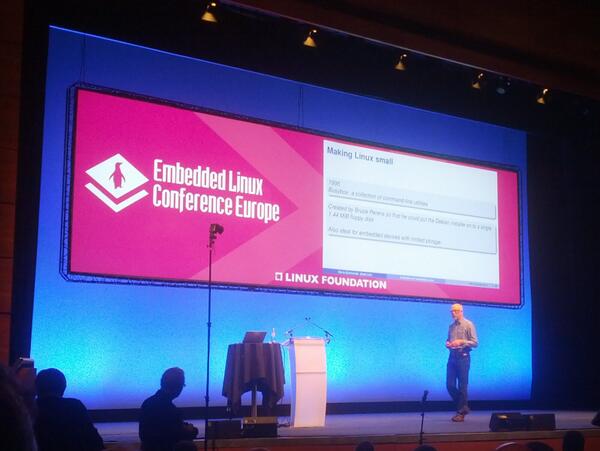
Slides from "A timeline for embedded Linux"
Tue, 10/29/2013 - 12:25 — csimmondsHere is a link to the slides from my keynote talk on the history of embedded Linux at Embedded Linux Conference Europe 2013 in Edinburgh.
There is more detail in this blog entry
Embedded Linux timeline
Sun, 07/22/2012 - 20:36 — csimmondsYou will find Linux inside a wide range of devices today, yet it was not intended to be used as an embedded operating system in the beginning. In trying to understand how Linux moved out of the pure PC environment and into the fabric of our technology I have put together the following timeline showing what I consider to be the important milestones. I am aware that it is missing many details, and I would welcome feedback and comments from all who may read this. Either post a comment at the bottom or mail me at "chris dot simmonds at 2net dot co dot uk".
Slides from the Embedded Live Confernece 2010: "Android Inside: tutorial" and "Reducing boot time in Linux devices"
Tue, 10/19/2010 - 20:56 — csimmondsFor those people who attended my lectures at the Embedded Live in Earl's Court, London this week, and for anyone else who is interested, here are my slides.
Using Qemu to emulate absent hardware
Thu, 09/23/2010 - 14:01 — csimmondsAt the end of one of my training courses recently we got into a discussion about how to continue working with the code and configurations developed during the course after everybody had gone home and they no longer had a target board. I said, you could use qemu to emulate an ARM target that is rather similar to the one we actually use. Thinking about it a bit more, I realise that the situation is general and common enough to be useful to many people (or so I hope) and so I have written this tutorial.
Getting to grips with Eclipse: cross compiling
Wed, 07/28/2010 - 16:02 — csimmondsIn this article I will show you how to use Eclipse to cross compile a program and run it on a development board. I am running the Helios release of Eclipse on Ubuntu 10.04 but it will work as described on a wide variety of versions of Linux and Eclipse. My target board has an ARM 926JE core and I am using an Ångström toolchain and root file system (http://www.angstrom-distribution.org/) but once again the information is generic and should work with pretty much any embedded Linux target and toolchain.
Android on the Digi ConnectCore Wi-i.MX51
Tue, 07/27/2010 - 10:18 — csimmondsAndroid is an interesting platform for embedded devices of many types, not just phones. There are ports for various development boards, including the Beagleboard. To get an idea of how easy it is to implement on a new platform, I ported it to the Digi Wi-i.MX51 Jumpstart board which I reviewed earlier (see http://www.embedded-linux.co.uk/hardware/ccwi.imx51). I will post full details to Inner Penguin later. In this article I just want to show the end result.
What else can you do with Android?
Mon, 07/26/2010 - 09:13 — csimmondsAndroid was developed initially as an operating system for smartphones, but now it is popping up in other devices such as netbooks, sat nav and ereaders, not to mention development boards like the ubiquitous Beagleboard. So, why would you choose Android over any other version of embedded Linux? I think it comes down to critical mass. Android is a known quantity, promoted by a well-known and wealthy organisation which creates a standard platform where non existed before. Whereas each implementation of Linux on an embedded device is (more or less) unique, implementations of Android are going to be (more or less) the same.
Embedded hardware: The Digi ConnectCore Wi-i.MX51 module and Jump Start Kit
Wed, 06/09/2010 - 17:03 — csimmondsRecently I had a chance to try out this kit and I thought I would share my experiences.
This is an “SoM” (System on Module), based on a Freescale i.MX515 processor (ARM Cortex A-8), clocked at 800 MHz, with 512 MiB SDRAM and 512 MiB NAND flash. As such it is ideal for driving a graphical display or for multimedia processing, but it is also cheap enough for simpler tasks that just need a lot of compute power such as encrypted communications. The module itself is about the size of a business card:
Slides from the Embedded Systems Confernece 2009: UBIFS, power management and porting
Fri, 10/09/2009 - 08:32 — csimmondsFor those people who attended my lectures at the Embedded Systems Conference in the UK this week, and for anyone else who is interested, here are my slides.
Linux flash file systems: JFFS2 vs UBIFS
Power saving in Linux devices
Why Linux is not an RTOS:porting hints
Hope you find them interesting: if not tell me about it...

 Twitter
 GitHub